
In the modern digital landscape, businesses no longer rely solely on traditional marketing channels like television, radio, or print media. Instead, brands are increasingly turning to social media advertising to connect with their audiences in a more direct, personalized, and impactful way. With billions of users actively engaging on platforms every day, social media has evolved into a dynamic marketplace where businesses can promote products, tell stories, and build lasting relationships.
Social media advertising is not just about boosting posts or running ads—it’s about understanding consumer behavior, leveraging data, and crafting meaningful experiences that resonate with the right audience at the right time. Whether you’re a startup, a small business, or a large enterprise, mastering social media advertising can significantly accelerate your growth.
This comprehensive guide will explore every aspect of social media advertising, including its importance, strategies, types, benefits, challenges, and future trends. By the end, you will have a clear understanding of how to effectively use social media advertising to achieve your business goals.
What is Social Media Advertising?
Social media advertising refers to the process of creating and placing paid promotional content on social media platforms to reach a targeted audience. These advertisements are designed to achieve specific objectives such as increasing brand awareness, generating leads, driving website traffic, or boosting sales.
Unlike organic social media marketing, which relies on unpaid reach, social media advertising ensures visibility by placing your content directly in front of users who are most likely to be interested in your offerings. This precision targeting is one of the biggest advantages of social media advertising.
Ads can appear in various formats, including images, videos, stories, and sponsored posts. They are typically integrated seamlessly into users’ feeds, making them less intrusive and more engaging compared to traditional ads.
The Evolution of Social Media Advertising
Social media advertising has undergone significant transformation over the years. Initially, platforms were primarily used for personal communication and networking. However, as user bases expanded, businesses recognized the potential to reach large audiences.
Early forms of social media advertising were simple banner ads and promoted posts. Over time, platforms introduced advanced targeting options, analytics tools, and diverse ad formats. Today, advertisers can create highly personalized campaigns based on user preferences, behaviors, and interactions.
Artificial intelligence and machine learning have further enhanced social media advertising by enabling predictive targeting, automated bidding, and real-time optimization. As a result, businesses can achieve better outcomes with greater efficiency.
Why Social Media Advertising is Important
1. Unmatched Audience Reach
Social media platforms are home to billions of users around the world, creating a vast global audience. This vast audience provides businesses with an opportunity to reach potential customers across different demographics, locations, and interests.
2. Precision Targeting
One of the greatest strengths of social media advertising is its ability to reach highly specific audiences. Advertisers can define their audience based on age, gender, location, interests, behaviors, and even past interactions with the brand.
3. Cost-Effectiveness
Social media advertising offers flexible budgeting options, making it accessible for businesses of all sizes. You can start with a small budget and scale your campaigns based on performance.
4. Measurable Results
Unlike traditional advertising, social media campaigns provide detailed insights and analytics. Metrics such as impressions, clicks, conversions, and engagement help businesses evaluate performance and optimize strategies.
5. Enhanced Engagement
Social media makes it possible for brands to interact directly with users. Customers can like, comment, share, and message, creating a two-way communication channel that strengthens relationships.
Key Social Media Advertising Platforms

Facebook
Facebook continues to be one of the most widely used platforms for advertising. It offers extensive targeting options, diverse ad formats, and robust analytics tools. Businesses can reach a broad audience and create highly customized campaigns.
Instagram is a visually driven platform that is ideal for brands focusing on aesthetics and storytelling. Features like Stories, Reels, and shopping integration make it a powerful advertising channel.
LinkedIn is mainly used for professional networking and business-to-business marketing. It is particularly effective for targeting professionals, decision-makers, and industry leaders.
TikTok
TikTok has quickly become popular, particularly with younger audiences. Its short-form video format encourages creativity and viral content, making it an attractive platform for brands seeking high engagement.
Twitter (X)
Twitter is effective for real-time marketing and engaging in trending conversations. It is often used for brand awareness, customer service, and event promotion.
Types of Social Media Ads
Image Ads
These are simple yet effective ads that use high-quality visuals to capture attention. They are easy to create and suitable for various marketing objectives.
Video Ads
Video content is extremely engaging and often communicates messages more effectively than static images. It is ideal for storytelling, product demonstrations, and brand awareness.
Carousel Ads
Carousel ads let businesses display multiple images or videos within a single advertisement. Users can swipe through the content, making it interactive and engaging.
Story Ads
Story ads appear in the stories section of platforms and provide a full-screen immersive experience. They are often time-sensitive and highly engaging.
Sponsored Posts
These ads integrate smoothly with organic content, making them feel less disruptive. They are designed to look like regular posts but are promoted to a wider audience.
Influencer Collaborations
Brands commonly partner with influencers to market and promote their products.This approach leverages the influencer’s audience and credibility to drive engagement.
How Social Media Advertising Works
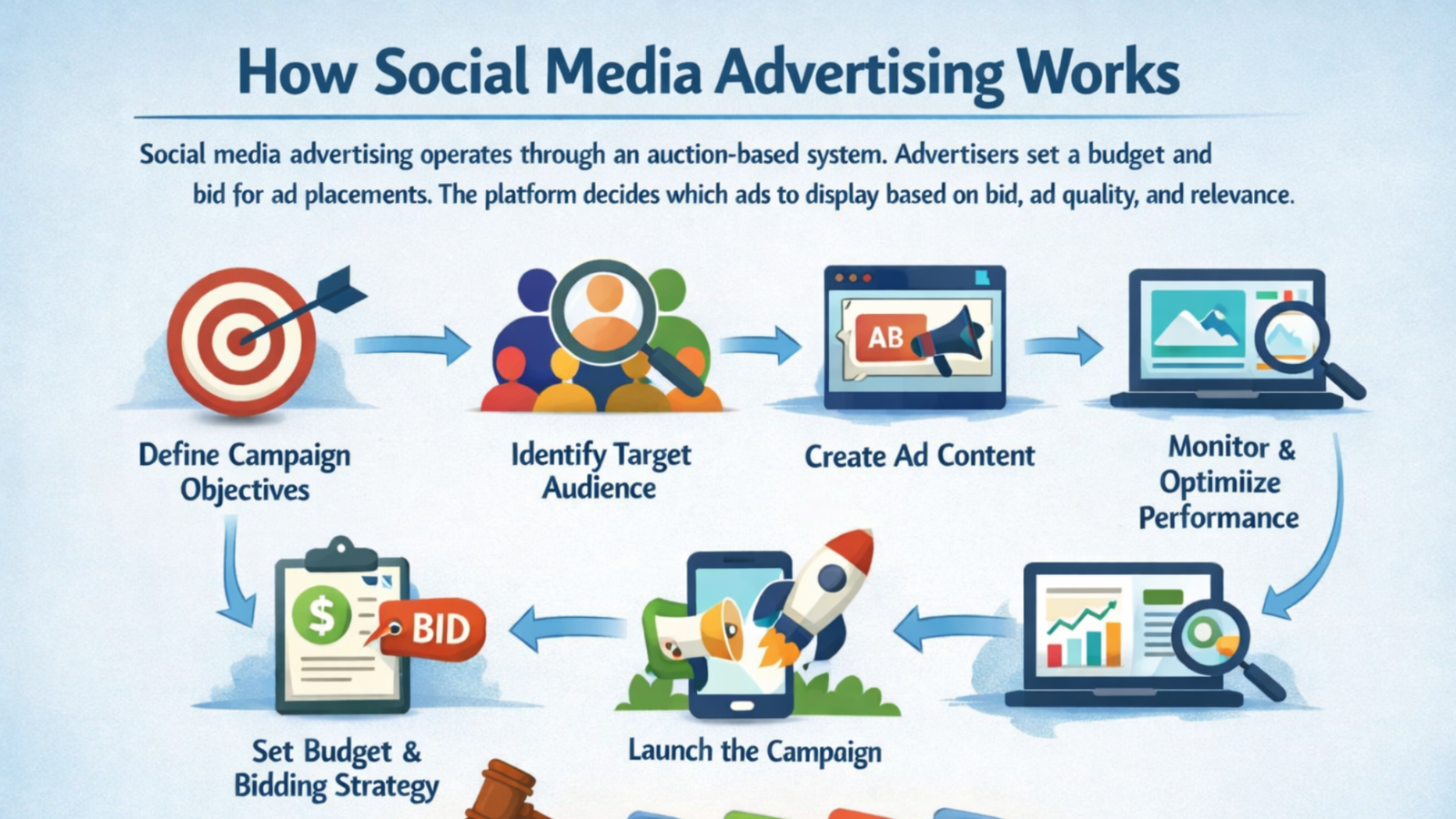
Social media advertising operates through an auction-based system. Advertisers set a budget and bid for ad placements. The platform then determines which ads to display based on factors such as bid amount, ad quality, and relevance.
The process typically involves:
- Defining campaign objectives
- Identifying target audience
- Creating ad content
- Setting budget and bidding strategy
- Launching the campaign
- Monitoring and optimizing performance
Creating an Effective Social Media Advertising Strategy
Define Your Goals
Before launching a campaign, it is essential to identify your objectives. Common goals include brand awareness, website traffic, lead generation, and sales conversions.
Understand Your Audience
Knowing your audience is crucial for success.Conduct research to gain insights into their preferences, behaviors, and challenges.
Choose the Right Platform
Different platforms serve different purposes. Choose the platform that best matches your target audience and aligns with your business objectives.
Create Engaging Content
Content is the backbone of social media advertising. Use high-quality visuals, compelling copy, and clear messaging to capture attention.
Set a Budget
Decide on your spending limit and distribute your budget strategically. Start small and increase spending based on performance.
Monitor and Optimize
Continuously track your campaign’s performance and make adjustments as needed. Testing different variations can help identify what works best.
Best Practices for Social Media Advertising
Use Strong Visuals
Using high-quality images and videos can greatly enhance engagement and boost conversion rates.
Write Clear and Compelling Copy
Your message should be concise, persuasive, and aligned with your audience’s needs.
Include a Clear Call-to-Action
Encourage users to take action, whether it’s clicking a link, signing up, or making a purchase.
Test Different Variations
A/B testing enables you to evaluate multiple versions of your ads to see which one performs best.
Optimize for Mobile
Ensure your ads are mobile-friendly, as most users access social media on their smartphones.
Common Challenges in Social Media Advertising
Increasing Competition
As more businesses invest in social media advertising, competition for attention and ad space continues to grow.
Ad Fatigue
Users may become less responsive to ads if they see the same content repeatedly. Regularly updating your creatives can help overcome this.
Algorithm Changes
Social media platforms regularly update their algorithms, which can affect how well ads perform.
Budget Constraints
Tight budgets can limit a campaign’s reach and effectiveness, making strategic planning crucial to maximize ROI.
Measuring Success in Social Media Advertising
Key performance indicators (KPIs) help evaluate the effectiveness of your campaigns. Some important metrics include:
- Impressions
- Click-through rate (CTR)
- Conversion rate
- Cost per click (CPC)
- Return on investment (ROI)
- Engagement rate
Analyzing these metrics enables businesses to make data-driven decisions and improve campaign performance.
Advanced Techniques for Better Results
Retargeting
Retargeting enables you to reconnect with users who have previously engaged with your brand.
Lookalike Audiences
Lookalike audiences help you find new users who share similar characteristics with your existing customers.
Personalization
Tailoring your ads to individual preferences enhances user experience and improves engagement.
Automation
Using automated tools can streamline campaign management and improve efficiency.
Future Trends in Social Media Advertising
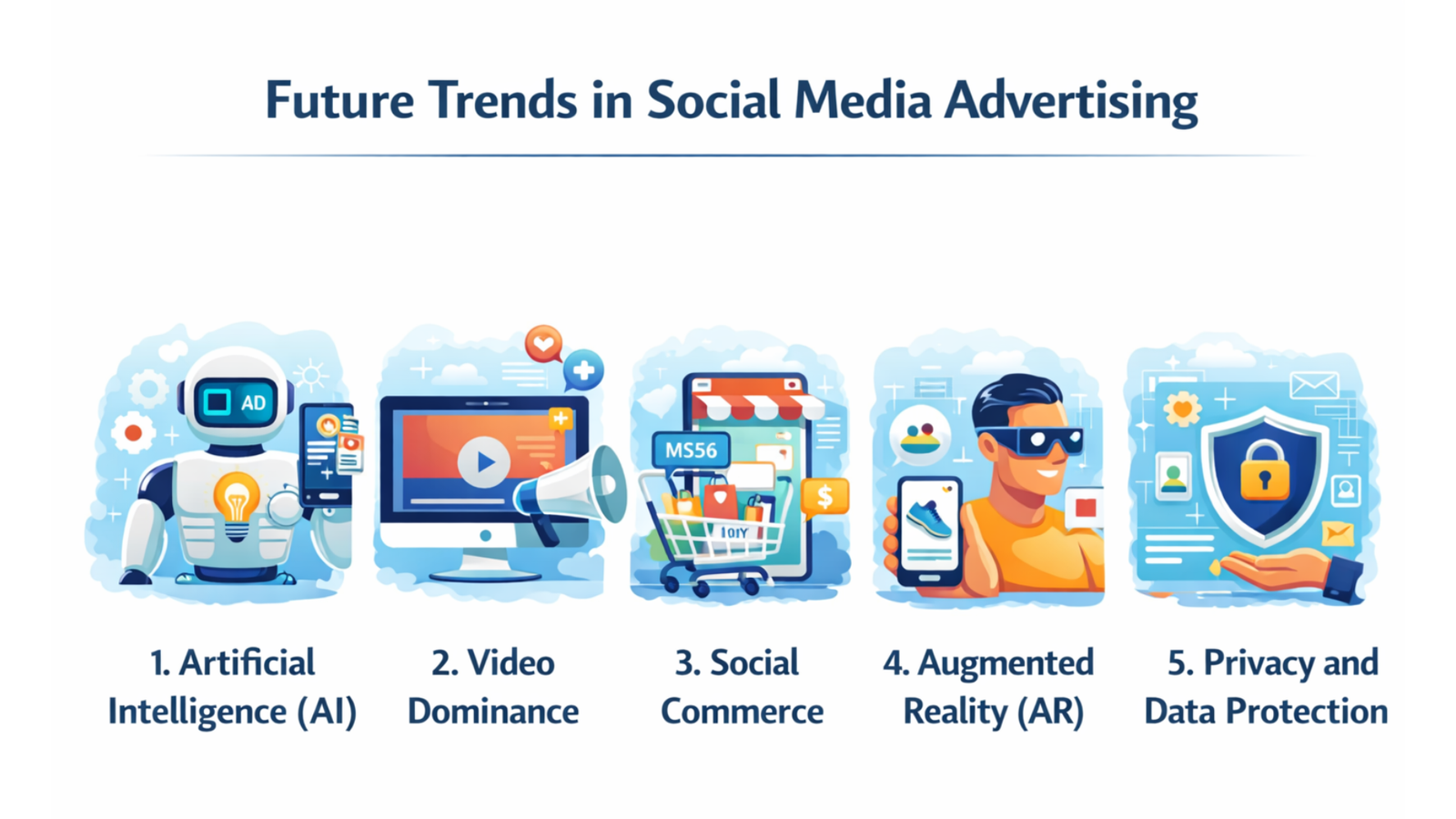
1. Artificial Intelligence (AI)
Artificial Intelligence is transforming how social media advertising works behind the scenes. Instead of manually selecting audiences or optimizing campaigns, AI can analyze massive amounts of user data in real time.
AI helps in:
- Audience targeting: It identifies users most likely to engage or convert based on behavior, interests, and past activity.
- Ad personalization: Ads are tailored to individual users, increasing relevance and effectiveness.
- Performance optimization: AI automatically adjusts bids, placements, and creatives to improve results.
- Predictive analytics: It can forecast trends and user actions, helping marketers make proactive decisions.
In the future, AI will make advertising more automated, efficient, and accurate, reducing guesswork and improving ROI.
2. Video Dominance
Video content, especially short-form videos, has become the most engaging format on social media. Platforms are prioritizing video because it captures attention quickly and keeps users engaged longer.
Why video is dominating:
- Higher engagement rates compared to text or image posts
- Better storytelling ability, allowing brands to connect emotionally
- Mobile-friendly format, ideal for today’s users
- Viral potential, especially with short videos
Short-form videos (like reels and clips) are particularly effective because they deliver quick, digestible content. In the future, brands will need to focus more on creative, authentic, and fast-paced video content to stay competitive.
3. Social Commerce
Social commerce is the integration of shopping experiences directly within social media platforms. Instead of redirecting users to external websites, customers can browse and purchase products without leaving the app.
Key advantages:
- Seamless shopping experience
- Reduced friction in the buying process
- Impulse purchasing opportunities
- Direct interaction between brands and consumers
Features like in-app checkout, product tagging, and live shopping events are making social media a powerful sales channel. This trend will continue to grow as platforms aim to become all-in-one ecosystems for both engagement and commerce.
4. Augmented Reality (AR)
Augmented Reality adds interactive digital elements to the real world through a device, such as a smartphone camera. In advertising, AR creates immersive experiences that allow users to interact with products before buying.
Examples include:
- Trying on sunglasses, makeup, or clothes virtually
- Viewing how furniture looks in your home
- Interactive filters and branded effects
Benefits of AR advertising:
- Higher engagement and interaction
- Improved customer confidence before purchase
- Memorable brand experiences
As AR technology becomes more accessible, more brands will adopt it to stand out and create unique user experiences.
5. Privacy and Data Protection
With growing concerns about data privacy, users and governments are demanding more transparency and control over personal information. This is significantly impacting social media advertising.
Key changes include:
- Stricter data regulations (like consent-based tracking)
- Limited third-party data access
- Increased use of first-party data (data collected directly from users)
- More transparent advertising practices
For advertisers, this means:
- Rethinking targeting strategies
- Focusing more on trust and brand relationships
- Using ethical data collection methods
In the future, successful advertising will depend not just on data, but on building trust and delivering value to users.
Conclusion
Social media advertising has become a crucial element of contemporary marketing strategies. Its ability to reach targeted audiences, deliver measurable results, and foster engagement makes it a powerful tool for businesses of all sizes.
Success in social media advertising requires a combination of creativity, strategy, and data analysis. By understanding your audience, choosing the right platforms, and continuously optimizing your campaigns, you can achieve significant growth and long-term success.
As technology continues to evolve, staying updated with the latest trends and best practices will ensure that your social media advertising efforts remain effective and competitive.
author: shifa